Steel buried in soil or immersed in water will corrode unless something intervenes. Coatings provide the first line of defense, but no coating is perfect. Cathodic protection (CP) supplies the second line: an electrochemical technique that, properly designed and maintained, can control external corrosion of pipelines, tank bottoms, well casings and marine structures for decades.
Corrosion is an electrochemical process. On a corroding steel surface, anodic sites lose metal as iron ions while electrons flow to cathodic sites, where reduction reactions such as oxygen reduction occur. The soil or water acts as the electrolyte that completes the circuit.
Cathodic protection works by supplying electrons to the structure from an external source so that the entire surface becomes cathodic. When the structure is polarized sufficiently in the negative direction, the anodic reaction on the steel is suppressed. Corrosion does not disappear from the system; it is transferred to an anode that is designed to be consumed or that is made of a material that resists consumption.
In a galvanic system, the structure is electrically connected to a metal that is more active in the galvanic series — typically magnesium, zinc or aluminum alloys. The natural potential difference drives protective current, and the anode corrodes preferentially. Galvanic systems need no external power, are simple to install and are unlikely to cause interference on neighboring structures, but their driving voltage and current output are limited. They are well suited to well-coated, electrically isolated structures of modest size and to environments of relatively low resistivity.
An impressed current CP (ICCP) system uses an external DC power source, usually a transformer-rectifier, to drive current from relatively inert anodes — such as high-silicon cast iron, graphite or mixed metal oxide (MMO) — through the electrolyte to the structure. ICCP can deliver much higher current and is adjustable, making it the usual choice for long pipelines, large or poorly coated structures and high-resistivity soils. It requires power, routine maintenance and careful attention to stray current interference with other structures.
| Feature | Galvanic anodes | Impressed current |
|---|---|---|
| Power source | Natural potential difference | External rectifier |
| Current output | Low, self-limiting | High, adjustable |
| Typical anodes | Magnesium, zinc, aluminum alloys | High-silicon cast iron, graphite, MMO |
| Interference risk | Low | Higher; requires assessment |
| Best application | Small, well-coated, isolated structures | Long pipelines, large or bare structures |
The key U.S. standard for buried and submerged piping is AMPP SP0169 (formerly NACE SP0169), Control of External Corrosion on Underground or Submerged Metallic Piping Systems. It addresses coatings, electrical isolation, CP design, criteria for protection, and operation and maintenance. Two widely used criteria for steel and cast iron are:
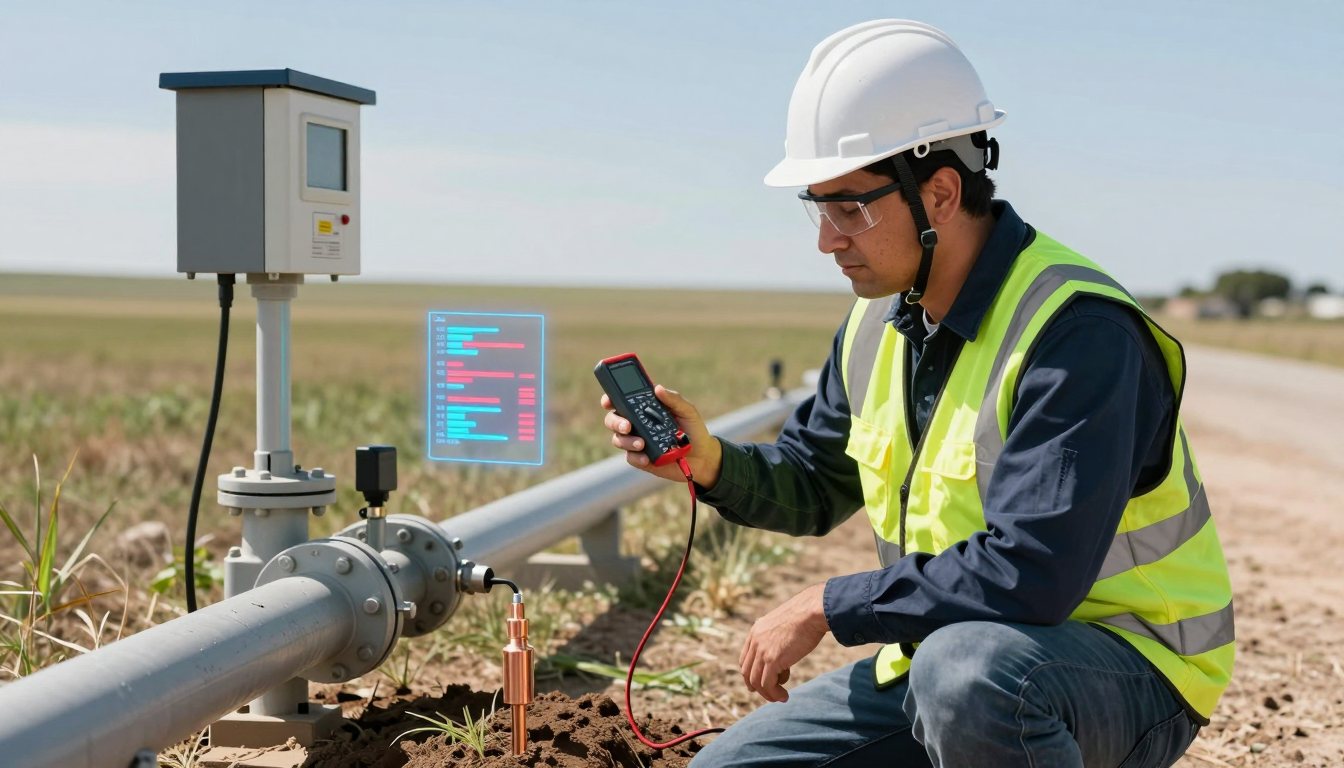
Both criteria refer to the polarized potential. A potential measured while protective current flows includes a voltage drop through the soil and coating, known as IR drop, that can make the structure appear better protected than it is. The usual way to account for it is the instant-off measurement: current sources are interrupted briefly and simultaneously, and the potential is read immediately after interruption, before the structure depolarizes. Where interruption is impractical, coupons or other methods may be used.
The standard also cautions against excessive polarization. Overly negative potentials can generate hydrogen at the steel surface, promoting coating disbondment and, in susceptible high-strength steels, hydrogen embrittlement.
A potential reading is only meaningful if you know what it includes. Understanding IR drop is the difference between measuring protection and assuming it.
For regulated pipelines in the United States, CP is not optional. The Pipeline and Hazardous Materials Safety Administration (PHMSA) requires external corrosion control, including CP and periodic monitoring, under 49 CFR Part 192 for gas pipelines and 49 CFR Part 195 for hazardous liquid pipelines. These regulations incorporate criteria and practices consistent with industry standards and specify monitoring frequencies for test stations and rectifiers. Other structures, such as underground storage tanks regulated under 40 CFR Part 280, have their own corrosion protection requirements.
A CP system must be verified throughout its life. Common activities include:
AC interference from parallel high-voltage power lines is a growing concern in shared utility corridors and requires dedicated assessment and mitigation.
CP work spans field measurement, interpretation and design. AMPP offers a tiered certification program for cathodic protection personnel, progressing from tester through technician and technologist to specialist. Federal pipeline regulations also require operator qualification for covered tasks, including many CP monitoring activities.
To develop field and design capability, explore IIME's Cathodic Protection Fundamentals training course.


 September 25, 2026 - BY Admin