
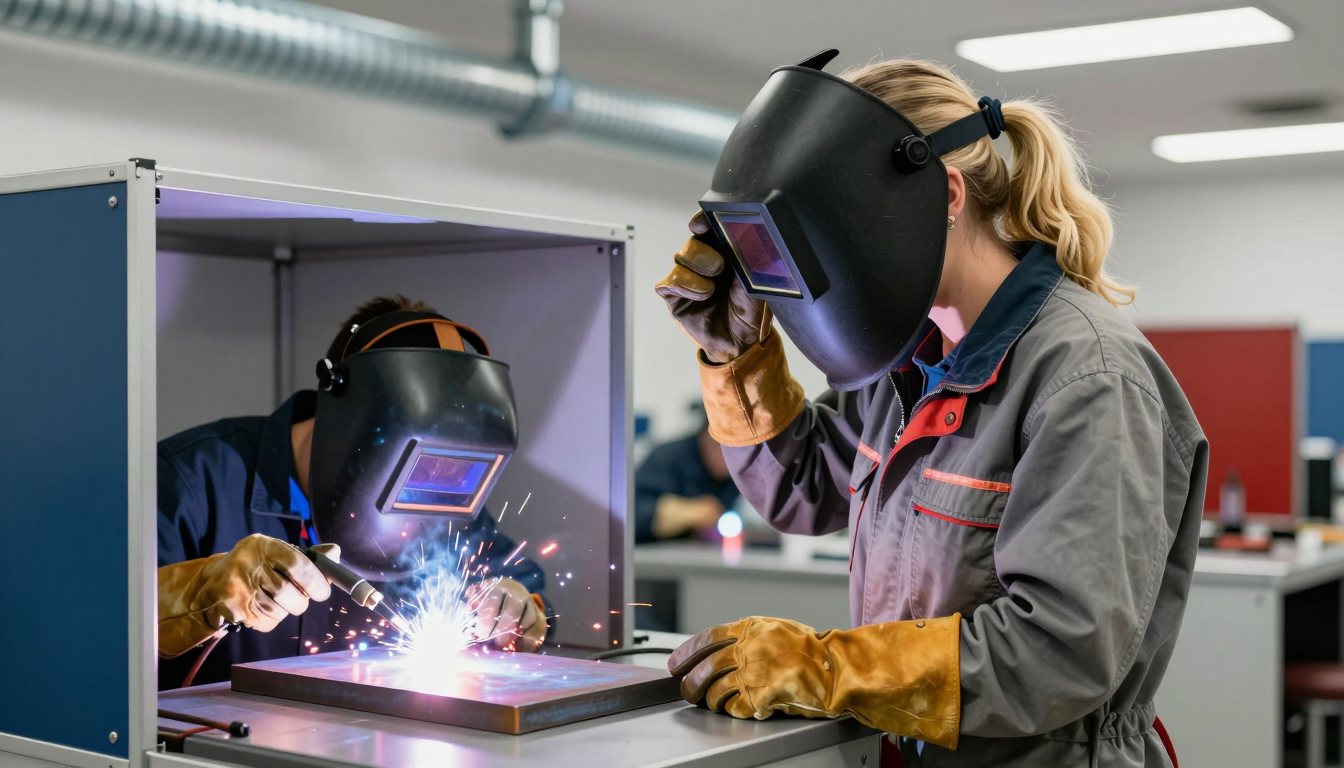
A sound understanding of how welding processes work is the starting point for every welder, supervisor and inspector. This five-day course introduces the basics of welding processes, equipment, safety and technique in a structured sequence of classroom and workshop sessions. Participants study the principles of shielded metal arc, gas metal arc, flux-cored and gas tungsten arc welding, the operation of power sources and accessories, the selection of consumables and the design of joints. Practical sessions develop correct technique in multiple positions and introduce the quality management and welder qualification requirements that apply to production work.
Who Should Attend
- Entry-level welders and welding apprentices
- Fabrication and maintenance personnel who weld as part of their duties
- Trainee welding inspectors and QA/QC staff
- Supervisors and engineers seeking practical welding knowledge
Learning Outcomes
- Apply welding safety procedures for fumes, radiation, electrical and fire hazards
- Explain the principles of SMAW, GMAW, FCAW and GTAW processes
- Set up and operate welding power sources and accessories correctly
- Select consumables and shielding gases for common carbon steel applications
- Interpret basic joint designs and welding symbols
- Produce fillet and groove welds using correct technique in common positions
- Recognize common weld discontinuities and their causes
Course Outline
- Module 1 — Welding Safety Procedures: PPE, ventilation, hot work, electrical safety and compressed gases.
- Module 2 — Introduction to Welding Processes: arc physics, SMAW, GMAW, FCAW and GTAW.
- Module 3 — Welding Equipment Operation: power sources, polarity, wire feeders and torches.
- Module 4 — Consumables and Materials: electrodes, filler wires, shielding gases and base metals.
- Module 5 — Joint Design and Welding Symbols: joint types, preparations and drawing interpretation.
- Module 6 — Types of Welding Techniques: travel angle, speed, weaving and multipass technique in various positions.
- Module 7 — Weld Quality: discontinuities, visual examination, welder qualification and quality systems.
Standards & References
Course content draws on AWS D1.1/D1.1M (Structural Welding Code — Steel); ISO 9606-1 (Qualification Testing of Welders — Fusion Welding — Steels); and ISO 3834 (Quality Requirements for Fusion Welding of Metallic Materials). Participants are introduced to the scope and application of each document; the current edition should always be consulted for project work.
Assessment & Certification
The program comprises 40 contact hours (5 days) of instruction. Assessment consists of a written examination and a practical assessment in which candidates produce test welds that are visually examined against defined acceptance criteria. Successful candidates receive an IIME Certificate of Training bearing a unique verification code, which can be verified online.
6 certificates issued for this program
- A ABDELAZIZ D.Iraqi
- H HAMZA S.Iraqi
- M MARWAN A.Iraqi
- L LAITH M.Iraqi
- M MUSA K.Iraqi
- S SAJJAD H.Iraqi