
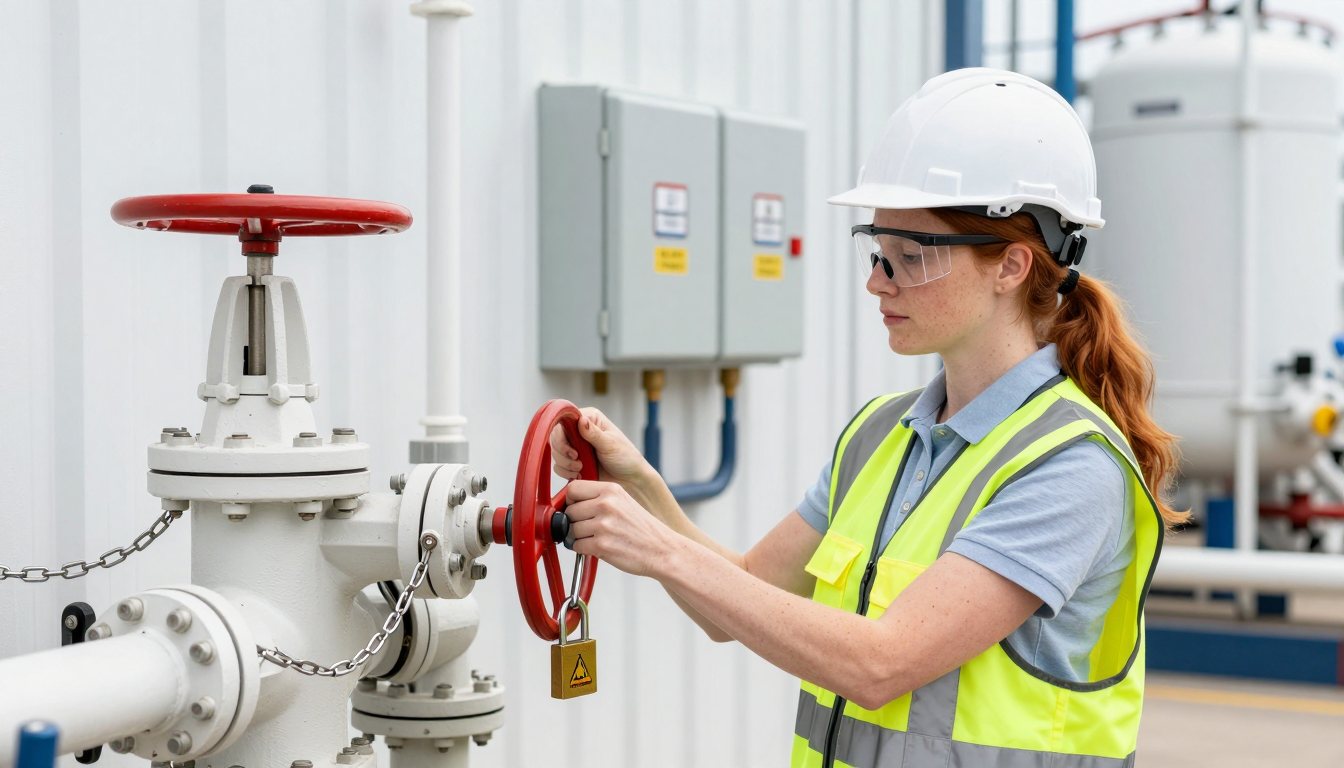
Failure to control hazardous energy during servicing and maintenance remains a leading cause of serious injuries in industry. This one-day course presents the principles and safe practices of mechanical isolation and lockout/tagout. Participants learn the requirements of the OSHA control of hazardous energy standard, the forms of energy that must be identified and controlled, and the methods of process and mechanical isolation used on pressurized systems, from valve isolation to positive isolation with blinds and spools. Practical exercises cover writing and applying energy-control procedures, verifying isolation and releasing equipment safely back to service.
Who Should Attend
- Maintenance technicians and operators who perform or permit isolations
- Supervisors and permit issuers
- Contractors working on energized or pressurized systems
- HSE personnel responsible for energy-control programs
Learning Outcomes
- Explain the requirements of OSHA 29 CFR 1910.147 and the roles of authorized and affected employees
- Identify mechanical, electrical, hydraulic, pneumatic, thermal, chemical and stored energy sources
- Select appropriate isolation methods, including double block and bleed and positive isolation
- Apply locks, tags and group lockout devices correctly
- Verify zero energy state before work begins
- Restore equipment to service following a controlled release sequence
Course Outline
- Module 1 — Principles of Mechanical Isolation: isolation hierarchy, valves, blinds, spools and bleeds.
- Module 2 — Lockout/Tagout Requirements: energy-control programs, procedures, training and periodic inspection.
- Module 3 — Standards and Legal Framework: OSHA 29 CFR 1910.147, NFPA 70E, API RP 14C and API Standard 521.
- Module 4 — Isolation Procedures: preparation, shutdown, isolation, lock application and verification.
- Module 5 — Group Lockout and Shift Change: lockboxes, contractors and continuity of protection.
- Module 6 — Release from Lockout: inspection, notification, lock removal and restart.
Standards & References
Course content draws on OSHA 29 CFR 1910.147 (The Control of Hazardous Energy — Lockout/Tagout); NFPA 70E (Standard for Electrical Safety in the Workplace); API RP 14C (Analysis, Design, Installation and Testing of Safety Systems for Offshore Production Facilities); and API Standard 521 (Pressure-Relieving and Depressuring Systems). Participants are introduced to the scope and application of each document; the current edition should always be consulted for project work.
Assessment & Certification
The program comprises 8 contact hours (1 day) of instruction. Assessment consists of a written examination and a practical assessment in which candidates prepare and apply an energy-control procedure to a training skid. Successful candidates receive an IIME Certificate of Training bearing a unique verification code, which can be verified online.
2 certificates issued for this program
- M MURAD A.Iraqi
- S SAJJAD H.Iraqi