
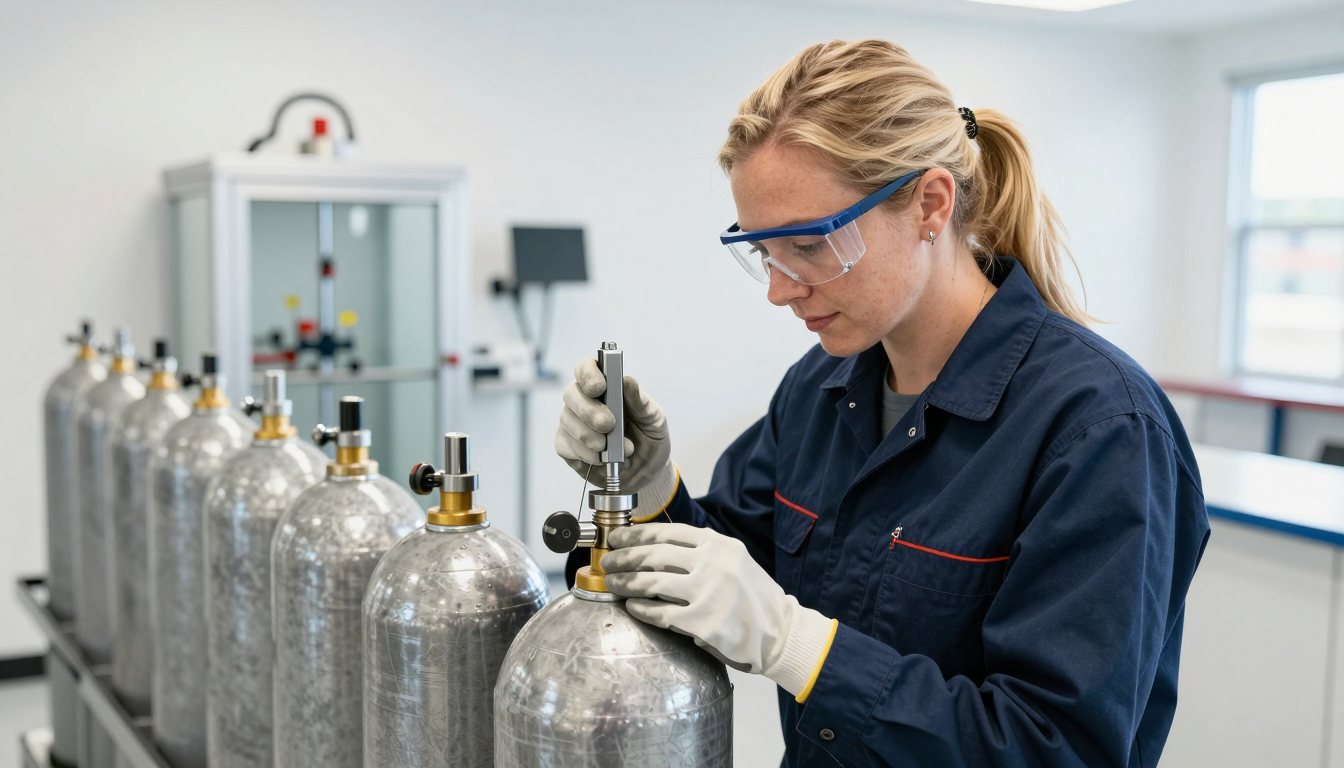
High-pressure gas cylinders store considerable energy, and a cylinder or valve failure can be violent and fatal. Periodic inspection and testing are therefore essential to confirm that cylinders remain fit for continued service. This course develops the practical competence to perform visual inspection, thread inspection with gauges, hydrostatic testing, valve testing, and routine maintenance of compressed gas cylinders. Participants learn to recognize rejectable defects such as dents, bulges, cuts, corrosion, heat damage, and suspicious markings, and to document results correctly in line with US requirements and international cylinder standards.
Who Should Attend
- Cylinder test station technicians and inspectors
- Gas filling plant operators
- Maintenance and HSE personnel managing cylinder fleets
- Quality personnel in industrial and medical gas facilities
Learning Outcomes
- Apply the gas laws to cylinder pressure, temperature, and filling calculations
- Perform external and internal visual inspection and apply rejection criteria
- Inspect cylinder neck threads using thread gauges
- Identify bulging, dents, cuts, fire damage, and suspicious marks
- Describe the hydrostatic test procedure and interpret expansion results
- Inspect, test, and maintain cylinder valves and pressure-relief devices
- Record inspection results and apply correct marking and disposition
Course Outline
- Module 1 — Gas Laws and Cylinder Fundamentals: pressure, temperature, and cylinder types
- Module 2 — Workshop Practices, Valves, and Safety: depressurization, valve removal, and safe handling
- Module 3 — Cylinder Visual Inspection Techniques: external and internal inspection and rejection criteria
- Module 4 — Cylinder Thread Inspection and Thread Gauges: thread forms, gauging, and damage assessment
- Module 5 — Checking for Bulging and Suspicious Marks: dimensional checks and stamping review
- Module 6 — Hydrostatic Testing: water-jacket method, permanent expansion, and test records
- Module 7 — Valve Testing and Maintenance: leak tests, valve servicing, and reassembly
Standards & References
ISO 10961 — Gas cylinders: cylinder bundles; ISO 8573 — Compressed air: contaminants and purity classes; ISO 10297 — Gas cylinders: cylinder valves; OSHA 29 CFR 1910.253 — Oxygen-fuel gas welding and cutting; NFPA 55 and NFPA 58. US requalification references include DOT 49 CFR 180.205 and Compressed Gas Association publications CGA C-1 (hydrostatic testing) and CGA C-6 (visual inspection of steel cylinders).
Assessment & Certification
Candidate competence is evaluated through a written examination and a practical assessment in visual and thread inspection and valve testing. Successful candidates receive an IIME Certificate of Training bearing a unique verification code that can be confirmed online. The program comprises 24 contact hours (3 days). In the United States, requalification of DOT-specification cylinders additionally requires a Requalifier Identification Number issued by PHMSA.
3 certificates issued for this program
- A Assad H.Iraqi
- S Sultan S.Iraqi
- M Mohammed Y.Iraqi