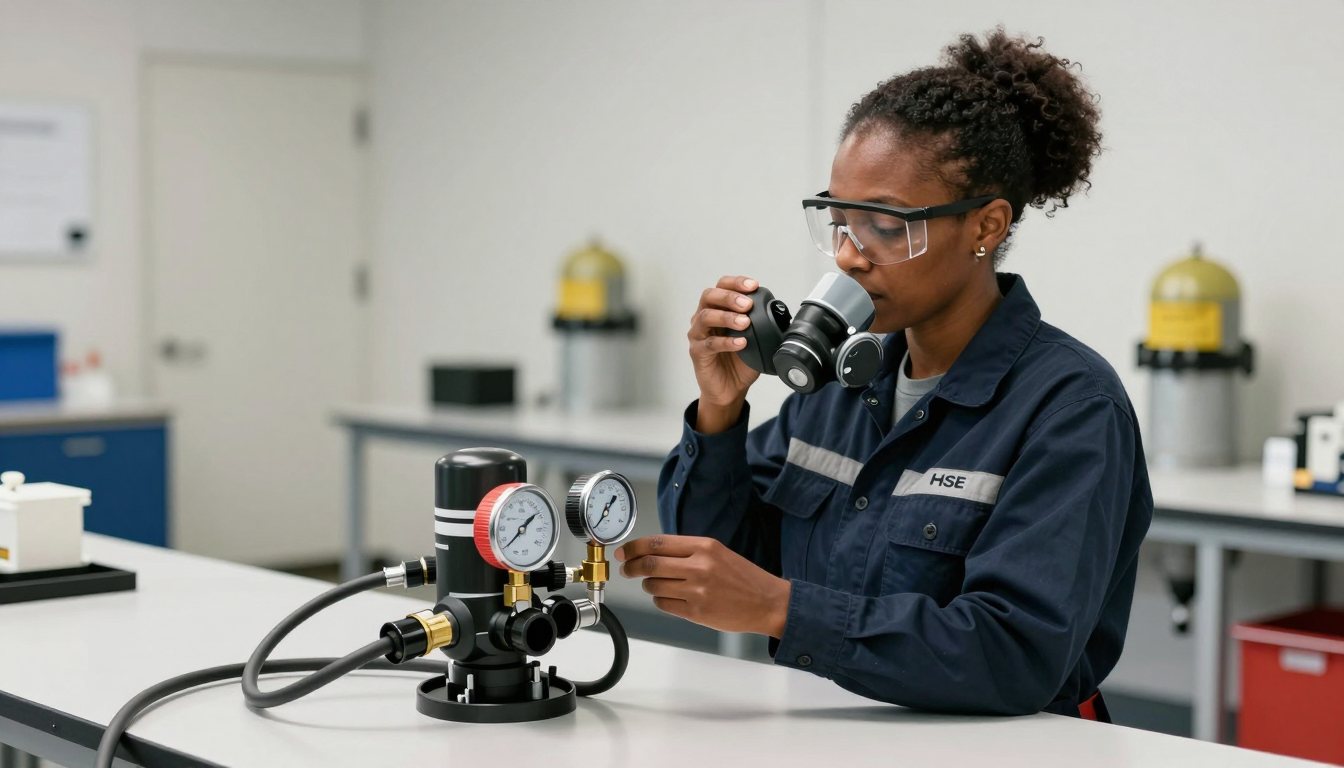
Self-contained breathing apparatus protects workers in atmospheres that are immediately dangerous to life or health, and it must work correctly every time it is donned. This one-day course develops the competence to inspect, functionally test and maintain the operational readiness of SCBA in industrial and emergency response settings. Participants learn to identify SCBA components, apply inspection criteria and pass/fail conditions, carry out pre-use and routine inspections and perform functional performance checks. The course also covers cylinder inspection and handling, breathing air quality and the records required by the OSHA respiratory protection standard. Practical work is carried out on industry-standard open-circuit SCBA, and the manufacturer's maintenance instructions govern all servicing beyond user-level inspection.
Who Should Attend
- Emergency response team members and fire brigade personnel
- HSE technicians responsible for respiratory protective equipment
- Confined space entry and rescue personnel
- Supervisors managing respiratory protection programs
Learning Outcomes
- Identify SCBA components and describe their function
- Perform pre-use and routine monthly inspections using a structured checklist
- Apply pass/fail criteria and remove defective apparatus from service
- Carry out functional checks of regulators, alarms and facepiece seal
- Inspect, handle and store compressed air cylinders correctly
- Maintain inspection records in line with OSHA 29 CFR 1910.134
Course Outline
- Module 1 — SCBA Components Identification: harness, cylinder, valve, regulators, facepiece and alarms.
- Module 2 — Respiratory Protection Requirements: OSHA 29 CFR 1910.134 and NFPA performance requirements.
- Module 3 — Inspection Criteria and Pass/Fail Conditions: acceptance criteria and tagging.
- Module 4 — Pre-Use and Routine Inspections: checklists, frequencies and cleaning.
- Module 5 — Functional Performance Checks: leak, low-pressure alarm, bypass and facepiece checks.
- Module 6 — Cylinders, Breathing Air and Records: hydrostatic test dates, Grade D air and documentation.
Standards & References
Course content draws on NFPA 1981 (Open-Circuit Self-Contained Breathing Apparatus for Emergency Services), whose requirements are now consolidated into NFPA 1970; and OSHA 29 CFR 1910.134 (Respiratory Protection), including its breathing air quality provisions referencing CGA G-7.1 Grade D air. Participants are introduced to the scope and application of each document; the current edition should always be consulted for project work.
Assessment & Certification
The program comprises 8 contact hours (1 day) of instruction. Assessment consists of a written examination and a practical assessment in which candidates inspect and functionally test an SCBA set and complete an inspection record. Successful candidates receive an IIME Certificate of Training bearing a unique verification code, which can be verified online.
12 certificates issued for this program
- A AHMED K.Iraqi
- H HUSSEIN A.Iraqi
- A AHMED H.Iraqi
- M MAJED O.Iraqi
- M MONAF K.Iraqi
- H HUSSAIN A.Iraqi
- A ARSHED E.Iraqi
- H HASANAIN A.Iraqi