
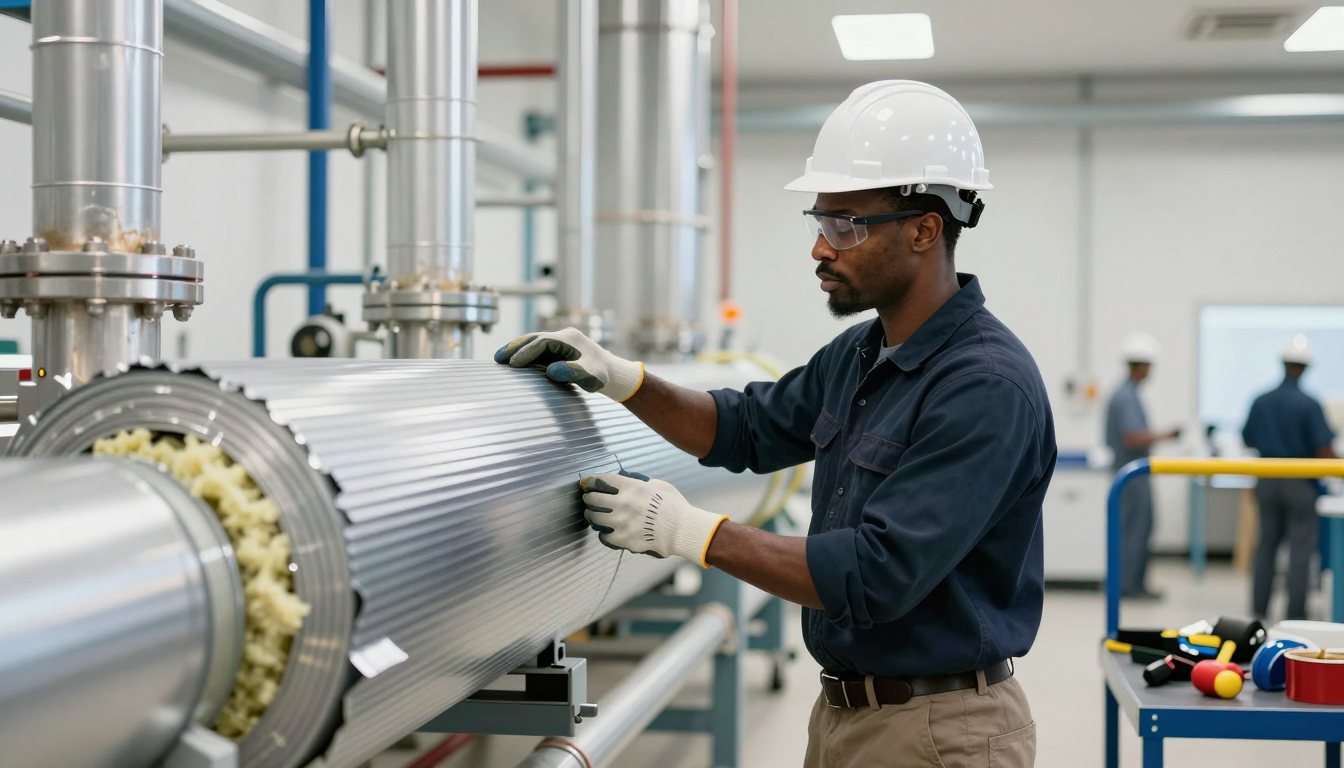
Industrial insulation conserves energy, maintains process temperatures, prevents condensation, attenuates noise, and protects personnel from hot surfaces. Poorly installed insulation, however, wastes energy and admits water that drives corrosion under insulation. This Level 1 course develops the practical competence to install insulation systems correctly on piping, vessels, and equipment. Participants learn the purpose and specification of insulation, the physical forms and properties of common materials, system coding, accessories and fastenings, and the weatherproofing details that keep systems dry. Health and safety in insulation work is addressed throughout.
Who Should Attend
- Insulation installers and apprentices
- Cladding and sheet-metal workers on industrial projects
- Maintenance personnel responsible for insulation repair
- Supervisors and inspectors of insulation contractors
Learning Outcomes
- Explain the purposes of thermal insulation and interpret insulation specifications
- Identify insulation materials by physical form and select them for hot, cold, and acoustic service
- Interpret insulation terms, system codes, and thickness requirements
- Install pipe sections, blankets, and boards using correct accessories and fastening methods
- Apply jacketing, vapor retarders, and weatherproofing details that prevent water ingress
- Recognize installation defects that lead to energy loss and corrosion under insulation
Course Outline
- Module 1 — Purpose of Thermal Insulation and Specification: heat conservation, cold service, process control, acoustics, and personnel protection
- Module 2 — Insulation Materials and Physical Forms: mineral wool, calcium silicate, cellular glass, and foams
- Module 3 — Insulation Terms, Systems, Coding, and HSE: thermal properties, system codes, and safe handling
- Module 4 — Accessories and Fastening Materials: bands, wires, pins, sealants, and supports
- Module 5 — Installation on Piping and Equipment: straight runs, fittings, valves, flanges, and vessels
- Module 6 — Jacketing and Weatherproofing: metal cladding, vapor retarders, and water-shedding details
- Module 7 — Inspection and Quality: workmanship standards and avoidance of CUI
Standards & References
ISO 8497 — Thermal insulation: determination of steady-state thermal transmission properties of thermal insulation for circular pipes; ASTM C680 — Practice for estimate of the heat gain or loss and the surface temperatures of insulated systems; DIN 4108-10 — Thermal insulation and energy economy in buildings: application-related requirements for thermal insulation materials. ASTM C1696 (guide for industrial thermal insulation systems) and ASTM C1055 (heated system surface conditions that produce contact burn injuries) are also referenced.
Assessment & Certification
Candidate competence is evaluated through a written examination and a practical assessment in which candidates insulate and clad a piping assembly including a valve and elbow. Successful candidates receive an IIME Certificate of Training bearing a unique verification code that can be confirmed online. The program comprises 40 contact hours (5 days).
6 certificates issued for this program
- N NEDYAR S.Iraqi
- A ADNAN H.Iraqi
- K KOVAN M.Iraqi
- M MUHAMMAD M.Iraqi
- F FIRSAT S.Iraqi
- S SHERWAN S.Iraqi