
Cathodic protection systems only protect buried and submerged structures when they are tested, evaluated and maintained correctly. This five-day course provides the technical foundation for personnel who collect and interpret field data on galvanic and impressed current systems. Participants study the electrical and electrochemical principles behind corrosion and its control, then apply them through structure-to-electrolyte potential surveys, current measurements, continuity and isolation testing and rectifier checks. Emphasis is placed on accurate measurement technique, recognizing sources of error, and recording data that allows engineers to judge whether protection criteria are being met.
Who Should Attend
- Field technicians performing CP surveys on pipelines, tanks and plant piping
- Pipeline operators and integrity personnel new to cathodic protection
- Corrosion control assistants and coating inspectors expanding into CP
- Utility and municipal staff responsible for buried metallic assets
Learning Outcomes
- Explain basic electricity, polarity, current flow and electrochemical corrosion cells
- Describe the operating principles of galvanic and impressed current CP systems
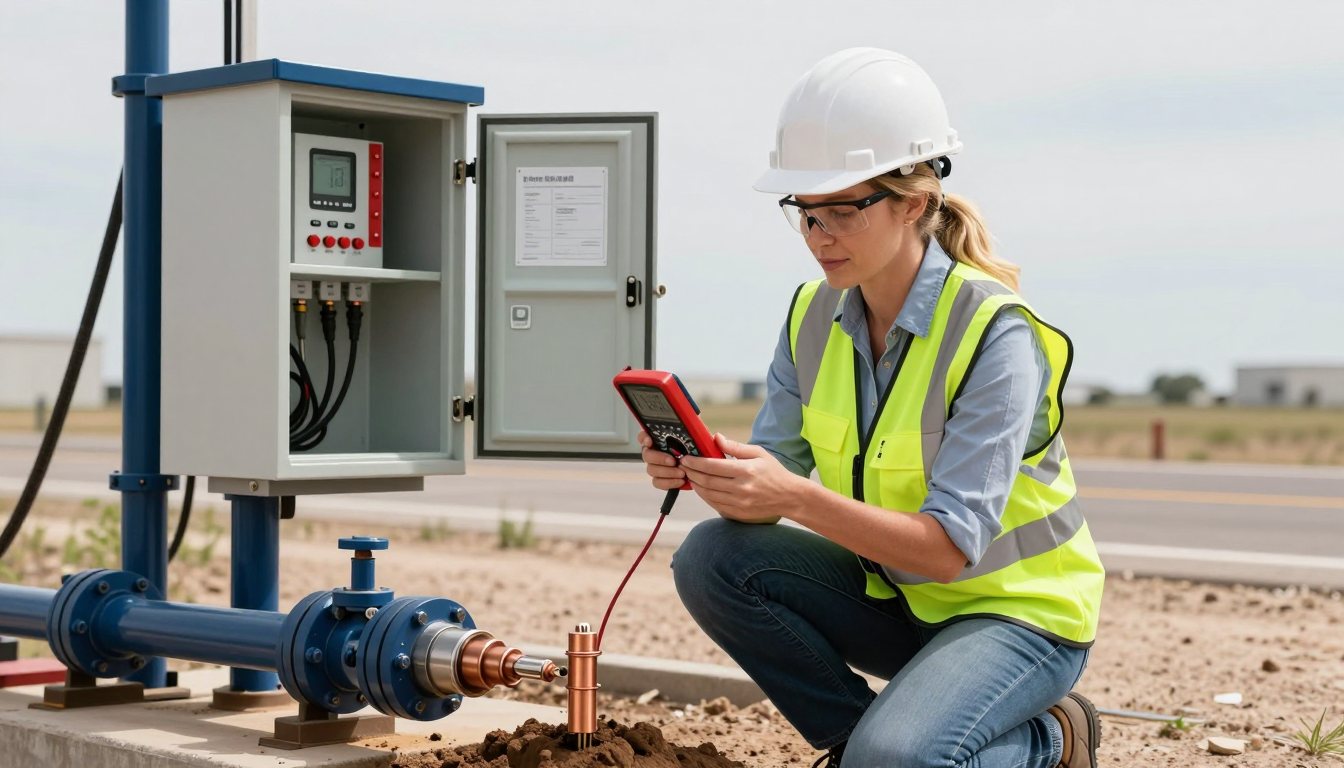
- Measure structure-to-electrolyte potentials using appropriate reference electrodes
- Conduct continuity, isolation and short-detection tests on protected structures
- Perform rectifier and anode current measurements and record readings correctly
- Recall code requirements and commonly applied protection criteria
- Identify measurement errors, including IR drop, and report data clearly
Course Outline
- Module 1 — Basic Electricity: voltage, current, resistance, Ohm's law, series and parallel circuits and polarity.
- Module 2 — Electrochemistry and Corrosion Theory: anodes, cathodes, electrolytes, corrosion cells and metal corrosion activity.
- Module 3 — Cathodic Protection Principles: galvanic and impressed current systems, components and current requirements.
- Module 4 — Field Instruments and Reference Electrodes: multimeters, copper/copper sulfate and silver/silver chloride electrodes and their care.
- Module 5 — Potential and Current Measurements: on and instant-off potentials, IR drop and current measurement techniques.
- Module 6 — Continuity, Isolation and Short Testing: isolating joints, casings, bonds and locating shorts.
- Module 7 — Codes, Criteria and Records: protection criteria, data recording, safety and reporting obligations.
Standards & References
Course content draws on ISO 12473 (General Principles of Cathodic Protection in Seawater); ISO 15589-1 and ISO 15589-2 (Cathodic Protection of Pipeline Systems, Onshore and Offshore); BS EN 12954 (Cathodic Protection of Buried or Immersed Metallic Structures); BS EN 13636 (Cathodic Protection of Buried Metallic Tanks and Related Piping); and AMPP (formerly NACE) standard practices, including AMPP SP0169. Participants are introduced to the scope and application of each document; the current edition should always be consulted for project work.
Assessment & Certification
The program comprises 40 contact hours (5 days) of instruction. Assessment consists of a written examination and a practical assessment covering potential measurements, continuity and isolation tests, and the recording of field data. This is an independent IIME training program and is not an AMPP certification. Successful candidates receive an IIME Certificate of Training bearing a unique verification code, which can be verified online.
4 certificates issued for this program
- M MUHAYMAN K.Iraqi
- H HUSSAIN A.Iraqi
- H HASSAN J.Iraqi
- M MOHAMMED A.Iraqi