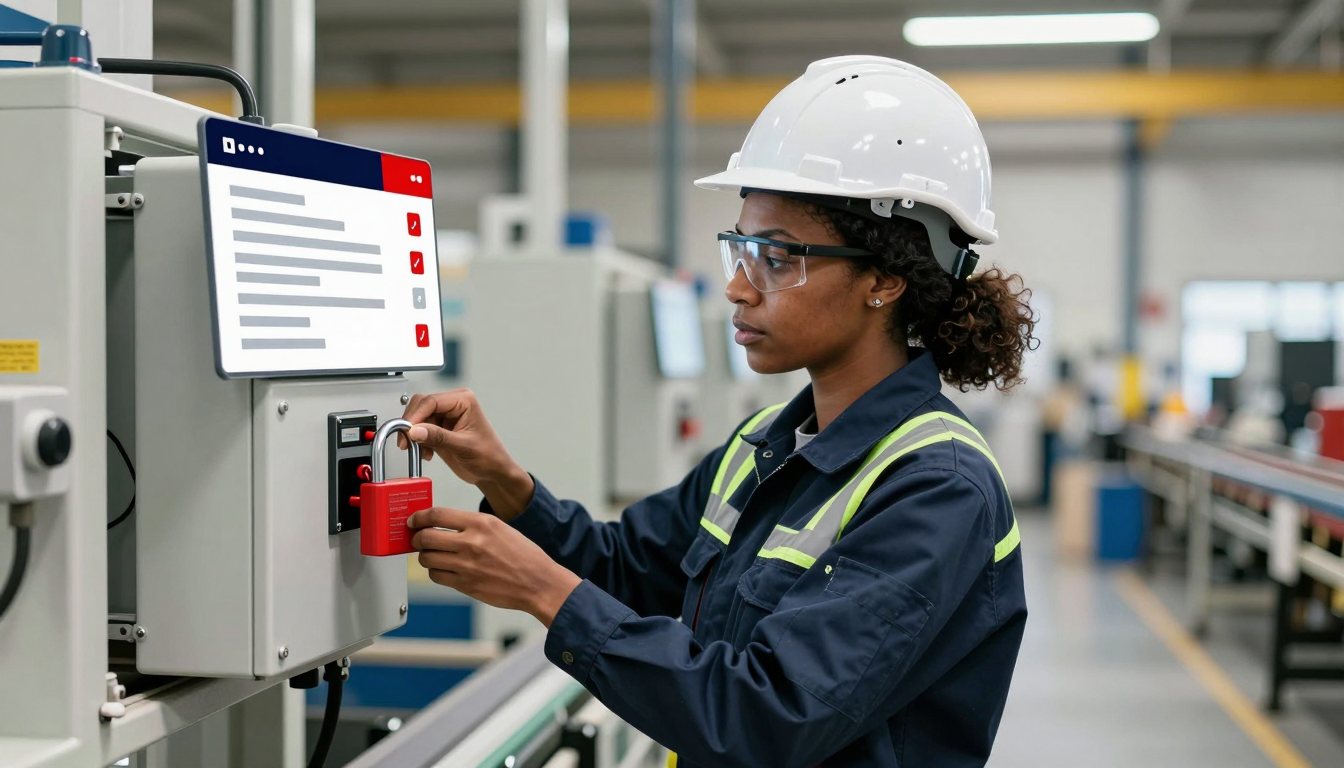
Servicing and maintenance tasks put workers in places machines were never designed for people to be: inside guards, between rollers, within reach of moving parts and stored pressure. When energy is released unexpectedly during that work, the results can be catastrophic. Lockout/tagout (LOTO) is the disciplined process that prevents it.
In U.S. general industry, the governing regulation is OSHA 29 CFR 1910.147, The Control of Hazardous Energy (Lockout/Tagout). It applies to servicing and maintenance of machines and equipment in which unexpected energization, startup or release of stored energy could harm employees. Related requirements include 29 CFR 1910.333 for electrical safety-related work practices, and the consensus standards ANSI/ASSP Z244.1 (control of hazardous energy) and NFPA 70E (electrical safety in the workplace), which many employers use to strengthen their programs.
The standard does not cover normal production operations unless workers must remove or bypass guards or place any part of their body in a danger zone. It also includes a narrowly defined exception for minor tool changes and adjustments that are routine, repetitive and integral to production, provided alternative measures give effective protection.
Electrical energy is the most familiar, but a competent energy control procedure considers all sources:
Mechanical and process equipment frequently has several of these at once. A pump may involve an electric motor, pressurized process fluid, elevated temperature and a coupled driver that can rotate from backflow.
OSHA 1910.147 requires employers to establish a program with three core components:
The regulation distinguishes between authorized employees, who lock out equipment to perform service, and affected employees, who operate or work near the equipment and must understand the purpose of the procedure and not attempt to restart locked-out equipment.
Verification is the step that catches every error made in the five before it. Never skip the try-out.
A lock physically prevents operation of the isolating device; a tag is only a warning. The standard therefore requires lockout where the isolating device is capable of being locked. Tagout alone may be used only where the device cannot be locked, or where the employer can demonstrate that a tagout program provides protection equivalent to lockout, which generally requires additional measures such as removing a circuit element or blocking a control switch. Lockout and tagout devices must be durable, standardized, substantial and identifiable, and they must be used only for energy control.
| Situation | Key requirement |
|---|---|
| Group lockout | Each authorized employee affixes a personal lock to a group lockout device or lockbox; a primary authorized employee coordinates. |
| Shift or personnel changes | Specific procedures ensure continuity of protection during the orderly transfer of lockout devices. |
| Outside contractors | On-site employer and contractor inform each other of their energy control procedures. |
| Testing or positioning | A defined sequence for temporarily removing devices, energizing, testing and reapplying controls. |
Restoring equipment is as structured as isolating it. The work area is inspected to ensure nonessential items are removed and components are intact; all employees are safely positioned; affected employees are notified; and each lock or tag is removed by the employee who applied it. The standard provides a limited, documented exception for removal by the employer when the authorized employee is not available, with specific steps to verify that person's whereabouts and inform them before they resume work.
Most energy-control failures involve procedures that existed on paper but were bypassed under schedule pressure or not written for the specific equipment. Machine-specific procedures with photographs of isolation points, periodic field audits, and leaders who stop work when isolation is uncertain are what turn a compliant program into an effective one.
To strengthen your site's energy control practice, consider IIME's Hazardous Energy Control (Lockout/Tagout) training course.


 October 07, 2026 - BY Admin