Volumetric examination of welds is a cornerstone of quality assurance for pressure equipment, piping and structures. Three methods dominate the field: conventional ultrasonic testing (UT), phased array ultrasonic testing (PAUT) and radiographic testing (RT). Each can be the best choice in the right circumstances, and each can be the wrong one. Selecting well requires understanding what each method physically detects.
Radiography passes X-rays or gamma rays through the part and records the transmitted intensity on film or a digital detector. Regions with less material or lower density — porosity, slag, incomplete penetration — transmit more radiation and appear darker. RT is therefore inherently sensitive to volumetric flaws. Planar flaws such as cracks and lack of sidewall fusion are detected reliably only when they are oriented roughly parallel to the radiation beam; unfavorably oriented tight cracks can be missed.
Conventional UT introduces high-frequency sound through a single-element (or dual-element) transducer and detects reflections from interfaces. Because reflectors that are perpendicular to the beam reflect strongly, UT is generally well suited to detecting planar flaws, and it can estimate flaw depth and through-wall height. Results depend heavily on the operator's scanning technique and interpretation, and manual scans typically produce limited permanent records.
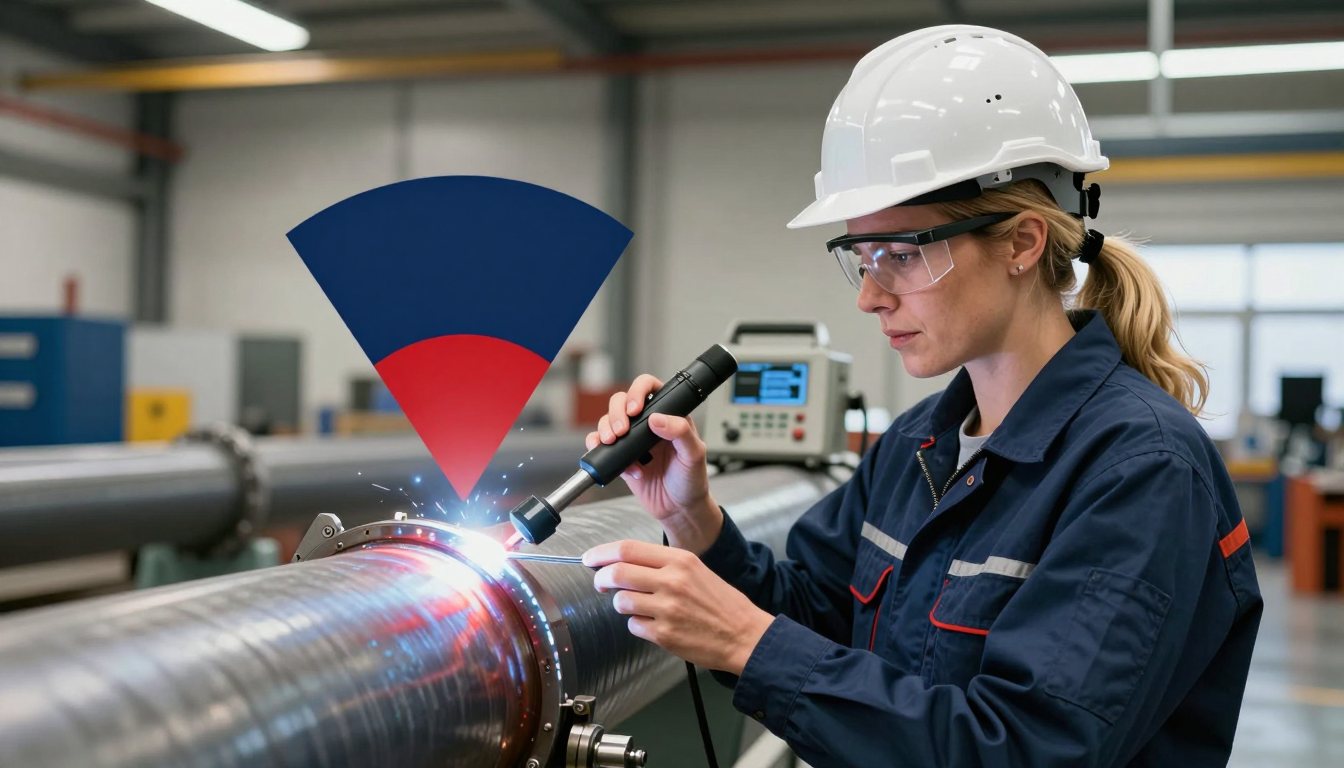
PAUT uses a probe containing many small elements that are pulsed with controlled time delays. By adjusting those delays electronically, the instrument steers and focuses the beam, sweeping a range of angles (a sectorial scan) or stepping the beam along the array (a linear scan) without moving the probe. Combined with an encoder, PAUT produces a recorded, reviewable data set showing the weld volume in multiple views. It is frequently combined with time-of-flight diffraction (TOFD), which uses diffracted signals from flaw tips to size through-wall height.
| Attribute | Radiography (RT) | Conventional UT | Phased array UT |
|---|---|---|---|
| Best detection | Volumetric flaws (porosity, slag) | Planar flaws, favorable orientation | Planar and volumetric across multiple angles |
| Through-wall sizing | Not directly measured | Possible, operator-dependent | Good; improved further with TOFD |
| Permanent record | Film or digital image | Limited for manual scans | Full encoded data set |
| Radiation hazard | Yes; exclusion zones required | None | None |
| Access needed | Both sides (source and detector) | One side | One side |
| Thin sections | Well suited | Can be challenging | Possible with appropriate probes and setups |
| Coarse-grained materials | Generally unaffected | Challenging | Challenging; special techniques may be needed |
The governing construction code determines which methods are permitted and how acceptance is judged. ASME Boiler and Pressure Vessel Code, Section V provides the examination methods: Article 2 covers radiography, including computed and digital radiography, and Article 4 covers ultrasonic examination of welds, including phased array and TOFD techniques. The referencing code then specifies when examination is required and the acceptance criteria.
Internationally, ISO 13588 addresses PAUT of welds, ISO 10863 covers TOFD and ISO 17636 covers radiography. The engineer must always confirm which edition and which specific provisions apply under the contract and jurisdiction.
Radiography requires controlled exclusion areas, and gamma sources in the United States are subject to Nuclear Regulatory Commission or Agreement State licensing, including the industrial radiography requirements of 10 CFR Part 34. On busy construction sites, RT often must be scheduled during off-shifts. Ultrasonic methods eliminate the radiation hazard and allow other crafts to keep working nearby, which can materially improve schedule.
If the concern is lack of fusion or cracking — the flaws most significant to structural integrity — ultrasonic methods with suitable angles usually provide better detection. If porosity and slag are the primary quality indicators, as in some workmanship-driven applications, RT remains highly effective.
Thin-wall small-bore piping, complex nozzle geometries and coarse-grained austenitic or dissimilar-metal welds can challenge ultrasonic techniques. RT may be simpler in those cases, or PAUT techniques may need specialized probes, modeling and qualification on representative mock-ups.
Encoded PAUT and TOFD data can be reanalyzed, audited and compared during later in-service inspections, which supports integrity management over the asset's life.
No method is universally superior. The right choice is the one whose physics matches the flaws that matter for that component, permitted by the governing code and executed by qualified personnel.
Advanced methods require advanced qualification. In the United States, personnel are commonly qualified under employer-based written practices per ASNT SNT-TC-1A or under ANSI/ASNT CP-189, while central certification under ISO 9712 is widely recognized internationally. Codes increasingly require that PAUT and TOFD personnel have method-specific training and practical demonstration, and that procedures be demonstrated on representative blocks containing known flaws.
To build proficiency in advanced ultrasonics, explore IIME's Phased Array Ultrasonic Testing (PAUT) Level II training course.


 September 13, 2026 - BY Admin