

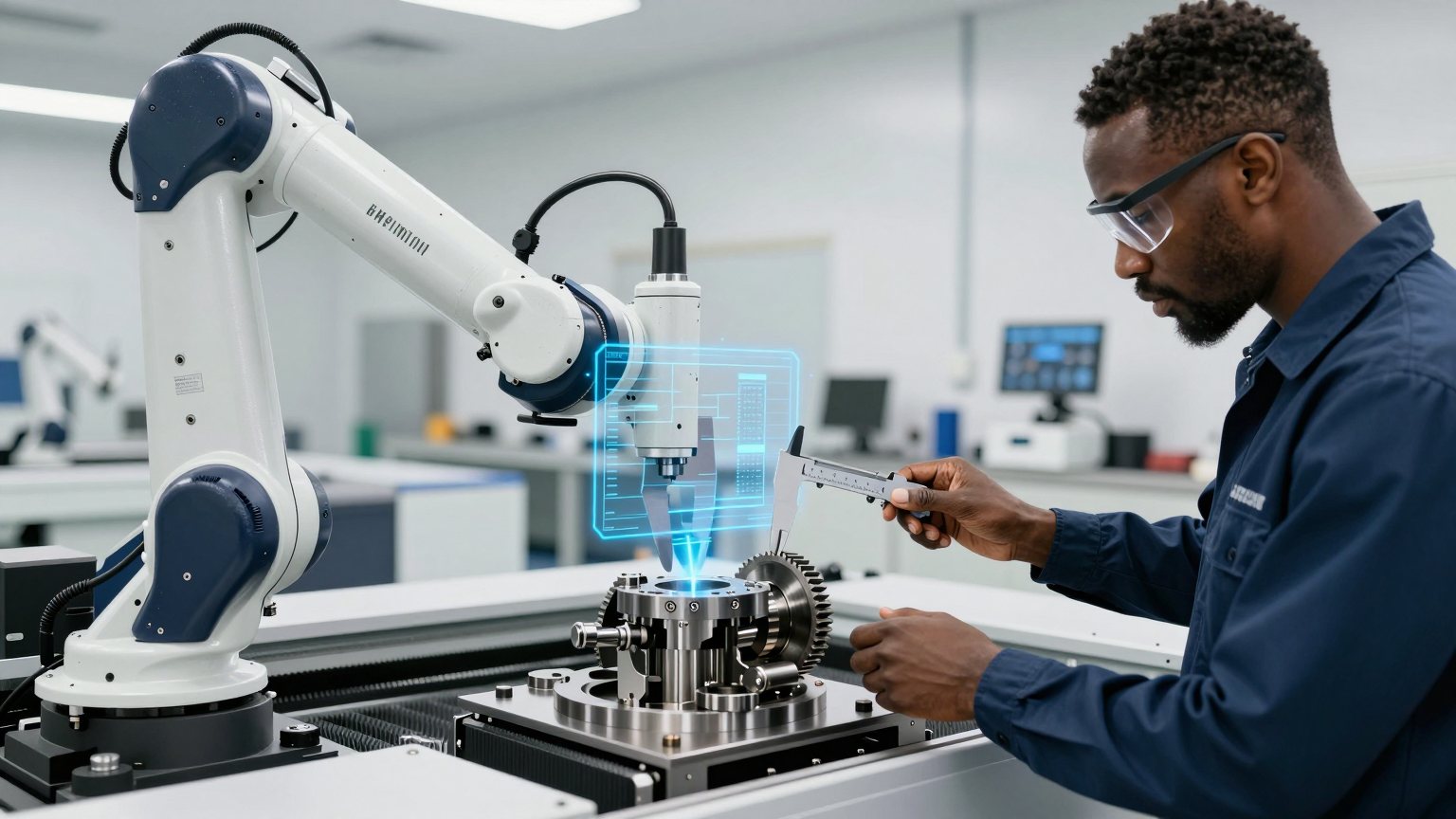
Modern manufacturing combines digital design, qualified joining processes, precision machining and disciplined maintenance. IIME supports manufacturers, fabrication shops and equipment builders with training pathways, examination-based personnel certification and competency assessment that connect the design office, the welding bay and the maintenance workshop through shared technical standards.
Sector challenges
Quality failures in manufacturing frequently originate upstream of the shop floor. Ambiguous drawings, incomplete dimensioning and inconsistent drafting practice create rework and nonconformances long before material is cut. In fabrication, welds produced without a qualified procedure, or by welders whose qualification does not cover the position or process in use, expose the organization to rejected work, customer audit findings and structural risk.
Production continuity depends equally on maintenance. Unplanned downtime on machine tools and production lines is commonly traced to misalignment, inadequate lubrication and poorly executed repairs. Where large components cannot be removed, in-situ machining offers a way to restore critical surfaces, provided the work is performed by trained personnel.
Manufacturing also carries significant occupational hazards: abrasive wheel failures, contact with moving machinery, unexpected energization during maintenance and collapse of overloaded storage racking. Each of these hazards is well understood and controllable through training and inspection.
How IIME supports your workforce
- Design-to-fabrication pathways linking engineering drawing production with welding procedure development and welder skills.
- Personnel certification with examination-based awards; every certificate carries a unique code that employers, clients and auditors can verify online at ii-me.us/verify.
- Workforce competency assessment for drafters, welders, machinists and maintenance technicians, supporting customer and quality-system audits.
- In-company delivery at the client's facility, using the client's own drawings, procedures and equipment where appropriate.
- Safety programs addressing abrasive wheel use, hazardous energy control and storage racking inspection.
- Training-center accreditation for technical colleges and providers serving manufacturing regions.
IIME programs for manufacturers are structured so that each discipline understands the requirements of the next. Drafters learn how drawing conventions are interpreted on the shop floor; welders learn how a procedure specification is developed and why its essential variables must be respected; maintenance technicians learn how precision in alignment and machining affects product quality. This shared technical language reduces rework and strengthens the documentation that customers and auditors expect from a qualified supplier.
Codes & standards we align with
- AWS D1.1 structural welding code (steel)
- ASME BPVC Section IX welding, brazing and fusing qualifications
- ISO 15614-1 welding procedure qualification and ISO 9606-1 welder qualification
- ASME Y14.5 dimensioning and tolerancing and ISO 128 technical drawing principles
- ANSI B7.1 and OSHA 29 CFR 1910.215 abrasive wheel safety
- OSHA 29 CFR 1910.147 control of hazardous energy
- ANSI MH16.1 and EN 15635 for storage racking design and in-service inspection
- ISO 45001 occupational health and safety management systems
IIME programs are designed to build the knowledge and practical skill that these documents presuppose. They do not replace certifications issued directly by code bodies or the qualification requirements set by an owner, jurisdiction or authorized inspection agency.
Recommended programs
The recommended programs below trace the manufacturing value chain, from technical drawing through welding procedure qualification and welder skill development to machining, maintenance and the inspection of workplace hazards. They can be combined into role-based curricula for new hires or used to formalize the competence of experienced staff.
- Autodesk AutoCAD Training – 2D Drawing Production
- Welding Process Principles and Practices
- Principles & Applications of PQR & WPS
- SMAW 3G Groove Welding Qualification Training
- In-Situ Machining
- Mechanical Maintenance Technician
- Grinding Machine Operator
- Warehouse Racking Inspection
Engagement models
Manufacturing clients most often use in-company cohorts for production teams and open enrollment for individual specialists and supervisors.
- Open enrollment: drafters, welders, technicians and supervisors attend scheduled programs alongside peers from other manufacturers.
- In-company cohorts: dedicated groups trained at the client's plant, aligned with production schedules and the client's quality system.
- Competency assessment: evaluation of production and maintenance personnel against defined role requirements, providing evidence for audits and customer qualification.
- Training-center accreditation: technical colleges and training providers may apply to deliver IIME manufacturing programs under institutional oversight.
Each engagement begins with a definition of the roles concerned, the tasks those roles perform and the evidence of competence the organization requires. Program selection, assessment design and certification scope follow from that definition, so that the outcome is a documented and verifiable record of workforce capability.