
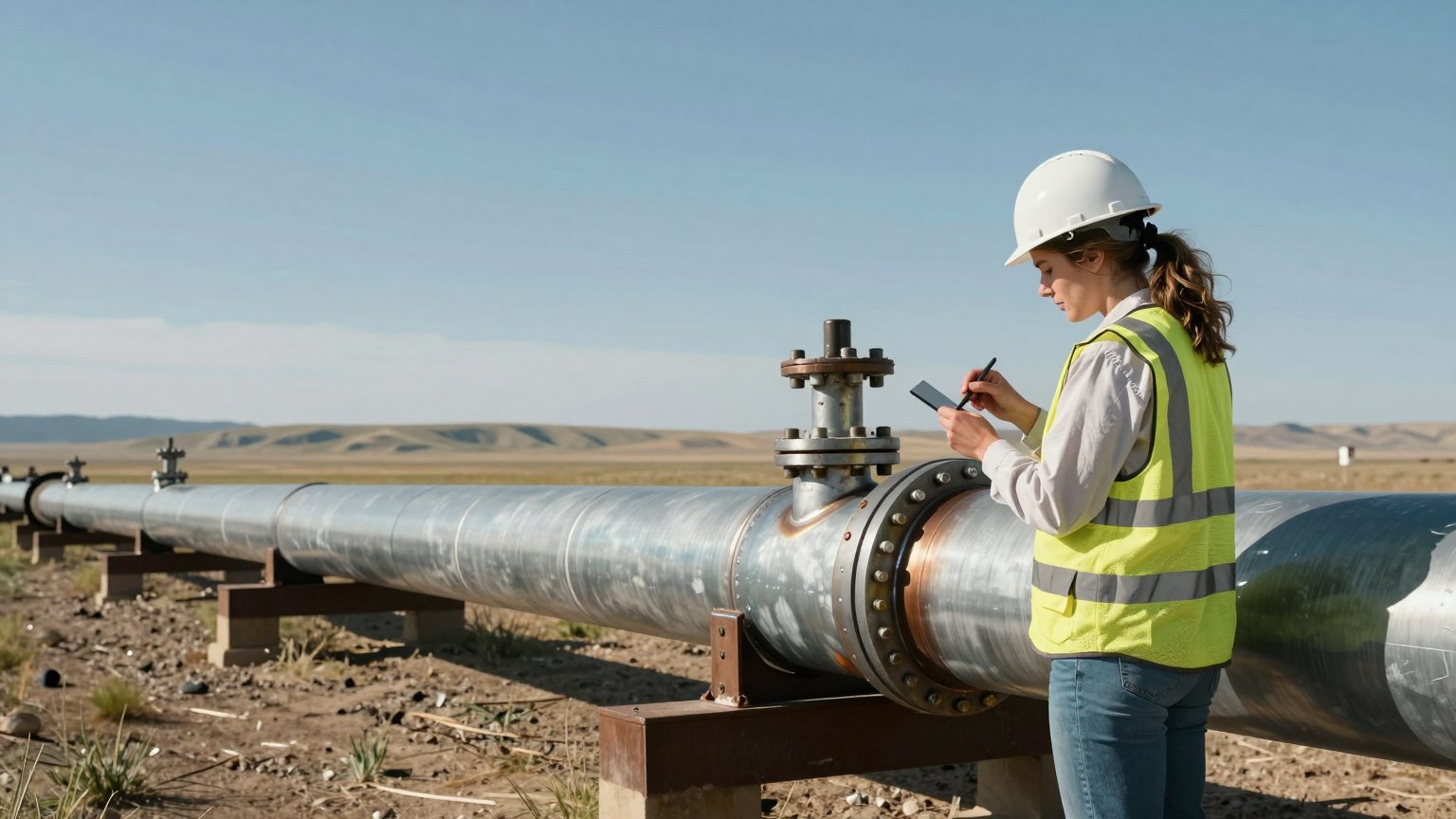
Pipelines transport hydrocarbons, water and gas over long distances through environments that are difficult to monitor and costly to access. IIME supports pipeline operators, construction contractors and integrity service companies with training pathways, examination-based personnel certification and competency assessment covering construction quality, pressure testing, corrosion control and polyethylene systems.
Sector challenges
The principal threats to pipeline integrity are well established: external and internal corrosion, girth weld and seam defects, mechanical damage from third-party activity, stress corrosion cracking and ground movement. For buried steel pipelines, coating condition and the effectiveness of cathodic protection determine whether external corrosion is controlled. Inadequate protection, or survey data that is incorrectly gathered or interpreted, allows corrosion to progress undetected.
Construction quality establishes the baseline for the entire operating life. Girth welds must be inspected to acceptance criteria that are increasingly applied through automated ultrasonic methods, and every new or repaired section must be pressure tested to demonstrate strength and leak tightness. Polyethylene distribution and water systems introduce a distinct set of risks, since fusion joint quality depends heavily on correct parameters, surface preparation and operator discipline.
In the United States, operators must also meet federal operator qualification requirements, which oblige them to show that individuals performing covered tasks are qualified. Documented training and assessment form an important part of that evidence.
How IIME supports your workforce
- Construction and commissioning pathways covering pipe fitting, weld inspection by automated ultrasonic testing and hydrostatic pressure testing.
- Corrosion-control pathways progressing from cathodic protection testing to installation.
- Personnel certification with examination-based awards; every certificate carries a unique code that employers, clients and auditors can verify online at ii-me.us/verify.
- Workforce competency assessment that supports operator qualification programs by documenting knowledge and observed task performance.
- In-company delivery for construction spreads, integrity crews and distribution teams, including field-based practical sessions.
- Training-center accreditation for providers serving pipeline construction and operations workforces.
IIME programs for pipeline personnel emphasize the reasoning behind field procedures as well as their execution. Technicians learn why test pressures and hold periods are specified as they are, how temperature changes influence the interpretation of a pressure test, what cathodic protection survey readings represent electrically, and why fusion parameters for polyethylene must be controlled closely. Personnel who understand these principles are better able to recognize anomalies and record data that integrity engineers can rely upon.
Codes & standards we align with
- ASME B31.4 liquid transportation pipelines and ASME B31.8 gas transmission and distribution piping
- 49 CFR Part 192 (gas) and 49 CFR Part 195 (hazardous liquids), including operator qualification requirements
- ASME B31.8S and API RP 1160 pipeline integrity management
- API Std 1104 welding of pipelines and related facilities
- API RP 1110 pressure testing of steel pipelines
- AMPP SP0169 control of external corrosion on underground or submerged metallic piping systems
- ASTM F2620 and ISO 21307 for polyethylene butt fusion, and ASTM F1055 for electrofusion fittings
- ISO 9712 qualification and certification of NDT personnel
IIME programs are designed to build the knowledge and practical skill that these documents presuppose. They do not replace certifications issued directly by code bodies or the qualification requirements set by an owner, jurisdiction or authorized inspection agency.
Recommended programs
The programs below address the pipeline life cycle from construction to operation: assembling and welding the line, inspecting girth welds, proving integrity through pressure testing, maintaining corrosion protection and joining polyethylene systems correctly.
- Pipe Fitting & Installation
- Automated Ultrasonic Testing (AUT) – Level II
- Hydrostatic Pressure Testing – Piping & Pipelines Leak Detection
- Hydrostatic Pressure Testing – Level II
- Cathodic Protection Tester (CP1)
- Cathodic Protection Installation Specialist
- HDPE Pipe Welding – Butt Fusion, Socket Fusion & Electrofusion
- High-Density Polyethylene (HDPE) Welding Inspection
Engagement models
Pipeline clients typically combine in-company cohorts for construction and integrity crews with competency assessment that supports their operator qualification programs.
- Open enrollment: technicians, inspectors and supervisors join scheduled programs alongside peers from other operators and contractors.
- In-company cohorts: dedicated groups trained on-site or at a nominated center, including field practical sessions where appropriate.
- Competency assessment: evaluation of personnel performing covered tasks, providing documented evidence that supports operator qualification records.
- Training-center accreditation: qualified providers serving pipeline regions may apply to deliver IIME programs and examinations under institutional oversight.
Each engagement begins with a definition of the roles concerned, the tasks those roles perform and the evidence of competence the organization requires. Program selection, assessment design and certification scope follow from that definition, so that the outcome is a documented and verifiable record of workforce capability.