
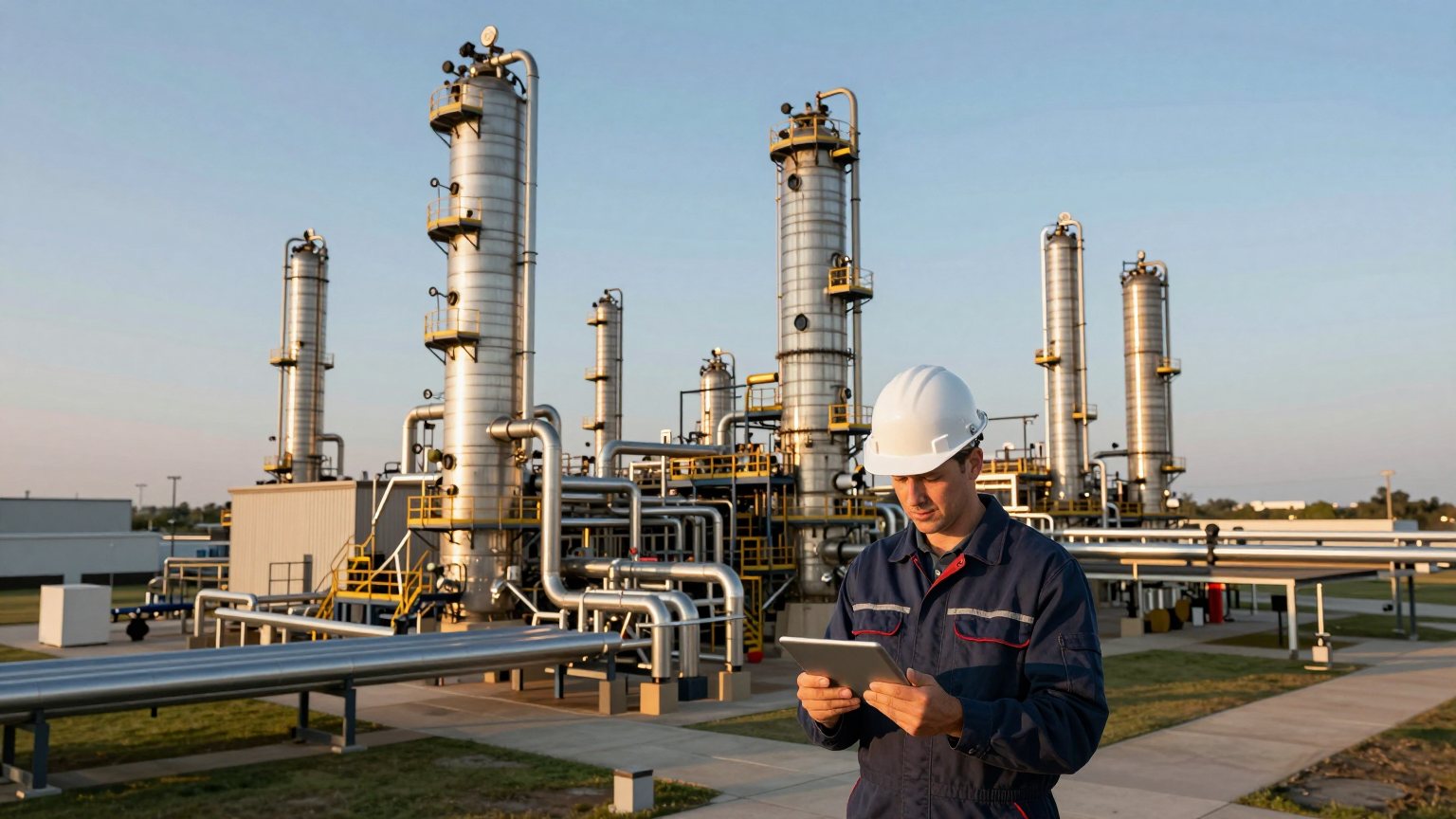
Oil and gas operations depend on people who understand pressure, materials and hazard in equal measure. The International Institute of Mechanical Engineering (IIME) provides operators, drilling contractors and service companies with structured training pathways, examination-based personnel certification and workforce competency assessment designed around the equipment and integrity obligations of upstream and midstream assets.
Sector challenges
Upstream and midstream facilities combine high pressures, flammable and frequently sour hydrocarbons, and remote or offshore locations where an error is difficult to recover from. Loss of containment remains the defining risk: leaking flanged joints, valve seat and stem failures, erosion of chokes and flowlines, and degradation of well barriers over the producing life of a well. Each of these failure modes has a technical root cause, and very often a human one, such as incorrect bolt-up, an incomplete isolation, or an inspection interval set without an understanding of the active damage mechanism.
Operators also face a persistent competency challenge. Experienced personnel retire, contractor crews rotate between assets, and regulators and insurers increasingly expect documented evidence that people performing safety-critical tasks are demonstrably competent rather than simply experienced. A credible training and assessment framework is therefore both an operational and a governance requirement.
How IIME supports your workforce
- Sector-specific training pathways that progress from foundational mechanical and safety knowledge to specialist topics such as well barrier management, choke valve maintenance and downhole measurement.
- Personnel certification with examination-based awards; every certificate carries a unique code that employers, clients and auditors can verify online at ii-me.us/verify.
- Workforce competency assessment combining written examination with observed practical tasks, producing a documented baseline against defined role requirements.
- In-company and group delivery at client facilities or regional centers, with case material drawn from the equipment the client actually operates.
- Training-center accreditation for organizations that wish to deliver IIME programs locally to oil and gas workforces under IIME quality oversight.
- Integrity-focused curricula addressing flange joint assembly, valve testing, isolation practice and risk-based inspection planning as connected disciplines rather than isolated skills.
IIME treats competence in this sector as the ability to perform a defined task correctly under field conditions, not simply as course attendance. Programs therefore emphasize the reasoning behind each procedure: why a barrier must be verified, why a joint must be assembled to a controlled bolt load, and why an isolation must be proven before work begins. Personnel who understand that reasoning are better equipped to recognize abnormal conditions and to stop work when necessary.
Codes & standards we align with
- API Spec 6A, wellhead and tree equipment
- API Std 53, well control equipment systems for drilling wells
- ISO 16530-1 and NORSOK D-010, well integrity across the well life cycle
- API Spec 6D and API 598, pipeline valves and valve inspection and testing
- API RP 580 and API RP 581, risk-based inspection
- ASME B31.3 process piping and ASME PCC-1 bolted flange joint assembly
- OSHA 29 CFR 1910.119 process safety management and 29 CFR 1910.147 control of hazardous energy
IIME programs are designed to build the knowledge and practical skill that these documents presuppose. They do not replace certifications issued directly by code bodies or the qualification requirements set by an owner, jurisdiction or authorized inspection agency.
Recommended programs
The programs below form a coherent pathway for oil and gas personnel, from well and pressure-control equipment through mechanical integrity and inspection planning to hazard identification and safe isolation. Organizations typically combine several of them into a role-based curriculum for operations, maintenance and integrity teams.
- Well Integrity Management
- External Sleeve Control Choke Valves – Level 1
- MWD and LWD Tool Physics and Applications
- Industrial Valves Inspection & Testing
- Flange Integrity Management System – Level 2
- API 580/581 Risk-Based Inspection (RBI)
- Principles of Hazard Identification & Risk Assessment
- Mechanical Isolation & Lockout/Tagout (LOTO) Safety
Engagement models
IIME engages with oil and gas organizations through four complementary models, which may be used independently or combined into a multi-year workforce development plan.
- Open enrollment: individual technicians, engineers and supervisors join scheduled programs alongside peers from other operators and contractors.
- In-company cohorts: dedicated groups trained at the client's facility or a nominated center, with scheduling planned around rotations and shutdowns.
- Competency assessment: structured evaluation of existing personnel against defined role profiles, identifying gaps before they become incidents.
- Training-center accreditation: qualified training providers serving oil and gas regions may apply to deliver IIME programs and examinations under institutional oversight.
Each engagement begins with a definition of the roles concerned, the tasks those roles perform and the evidence of competence the organization requires. Program selection, assessment design and certification scope follow from that definition, so that the outcome is a documented and verifiable record of workforce capability.